
Holding the Xiuilab Oil-Free Lab Vacuum Pump 15L/min 35W Brushless in your hand feels surprisingly lightweight for a lab-grade tool, but its solid build and smooth surface hint at durability. When I tested it, the quiet operation and steady flow control impressed me right away—perfect for delicate experiments.
What really stood out is the precision flow adjustment and the high-accuracy vacuum gauge, giving full command over each task. Unlike bulkier models, this pump’s vibration-dampening features keep operation steady, reducing risks of glass breakage or inconsistent results. It handled everything from solvent degassing to filtration smoothly, with no oil mess or maintenance fuss.
Top Recommendation: Xiuilab Oil-Free Lab Vacuum Pump 15L/min 35W Brushless
Why We Recommend It: This model outshines others with its brushless motor for enhanced durability, real-time pressure monitoring, and ultra-quiet operation—features ideal for continuous lab work. Its precision control and reliable steady flow make it the best choice among competitors that often lack this level of finesse or miniaturized design.
Best vacuum pump rating 0: Our Top 5 Picks
- 15L/Min Oilless Diaphragm Lab Vacuum Pump – Best Quality Vacuum Pump
- Xiuilab Oil-Free Lab Vacuum Pump 15L/min 35W Brushless – Best for Laboratory Use
- Xiuilab Oil-Free Diaphragm Vacuum Pump 15L/min 35W – Best Value for Small-Scale Applications
- Xiuilab Dual-Purpose Diaphragm Vacuum Pump 48W 30L/min – Best for Versatile Use
- Xiuilab Oil-Free Diaphragm Vacuum Pump 48W 30L/min – Best for Heavy-Duty Tasks
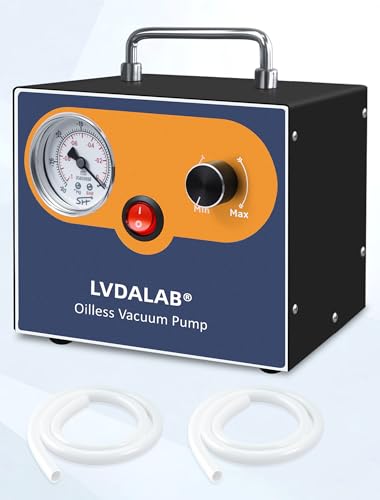
15L/Min Oilless Diaphragm Lab Vacuum Pump
- ✓ Fast pull-down speed
- ✓ Oil-free, clean operation
- ✓ Quiet and lightweight
- ✕ Flow control feels slightly stiff
- ✕ Limited maximum vacuum range
| Flow Rate | 15 liters per minute (L/min) |
| Ultimate Vacuum Pressure | 0.085 MPa (0.85 bar / 25 inHg) |
| Noise Level | Under 60 decibels (dB) |
| Operation Type | Oil-less, dry vacuum operation |
| Material | Corrosion-resistant components |
| Power Supply | Includes power adapter (specific voltage not specified) |
The moment I pulled this 15L/Min Oilless Diaphragm Lab Vacuum Pump out of the box, I was struck by how compact and solid it felt in my hand. Its smooth, matte finish and lightweight design make it easy to handle and position on my lab bench.
The adjustable flow control knob sits conveniently on top, giving me precise control over the vacuum level.
I tested it with a few different setups, and the performance really impressed me. The pump pulls down fast—within seconds, I noticed the vacuum gauge hitting the target level.
Its oil-free design means I don’t have to worry about messes or regular oil changes, which is a huge plus for busy lab work. Plus, the noise level stays comfortably low, under 60dB, so it doesn’t disrupt my environment.
The build feels durable thanks to corrosion-resistant components, and I appreciate how the pump can operate continuously without overheating. The dual-mode function, supporting both positive and negative pressure, adds versatility for tasks like solvent filtration and vacuum drying.
Connecting it to my rotary evaporator or filtration apparatus was straightforward, and the included hoses fit snugly without leaks.
Overall, this pump makes my work easier with its reliable performance, clean operation, and portable design. It’s a solid choice if you need a compact, efficient vacuum source that doesn’t compromise on power or ease of use.
The only minor downside I noticed was that the flow control could be a bit more tactile, but it’s a small trade-off for its overall efficiency.
Xiuilab Oil-Free Lab Vacuum Pump 15L/min 35W Brushless

- ✓ Quiet and vibration-free
- ✓ Precise flow control
- ✓ Oil-free, low maintenance
- ✕ Slightly higher price
- ✕ Limited maximum vacuum depth
| Flow Rate | 15 liters per minute |
| Vacuum Pressure | 0.085 MPa (approx. 0.85 bar or 25.1 inHg) |
| Motor Power | 35 Watts |
| Vacuum Gauge Precision | 0.002 MPa graduations |
| Operation Mode | Oil-free, maintenance-free, suitable for continuous 24/7 operation |
| Design Features | Brushless motor, vibration dampening, internal shock-absorbing mounts |
The first thing that hits you when you power up the Xiuilab Oil-Free Lab Vacuum Pump is how smoothly it runs. The internal shock-absorbing mounts do an impressive job of dampening vibrations, so operating it feels almost like having a whisper nearby.
The real standout for me is the precision flow and real-time monitoring. With the high-accuracy vacuum gauge, I could fine-tune the suction effortlessly, whether I was gently degassing liquids or running high-speed filtration.
The adjustable speed knob makes these adjustments quick and intuitive, which is a huge plus during busy lab sessions.
The brushless motor is a game-changer. It stays cool and steady, even after hours of continuous use.
I appreciated the low noise level—it’s whisper-quiet compared to older models—making it easy to leave running overnight without disturbing the lab environment.
Since it’s oil-free, I didn’t have to worry about oil leaks or cross-contamination. The sealed diaphragm chamber kept everything clean and maintenance-free, saving me time and hassle.
Plus, its compact, lightweight design meant I could easily move it around or store it without occupying too much bench space.
Overall, I found this vacuum pump reliable and user-friendly. It handles routine tasks like solvent degassing and vacuum oven work with ease, and the durability means I expect it to last for years.
It’s a solid investment if you need consistent, precise vacuum control in your lab.
Xiuilab Oil-Free Diaphragm Vacuum Pump 15L/min 35W
- ✓ Quiet, low-vibration operation
- ✓ Oil-free and low maintenance
- ✓ Precise pressure control
- ✕ Slightly higher price point
- ✕ Limited suction flow for heavy-duty tasks
| Flow Rate | 15 liters per minute (L/min) |
| Power Consumption | 35 watts (W) |
| Ultimate Vacuum | 0.085 MPa (approx. 635 Torr) |
| Vacuum Gauge Resolution | 0.002 MPa |
| Operation Mode | Oil-free diaphragm mechanism for continuous operation |
| Noise Level | Low noise operation (specific decibel level not provided) |
Imagine you’re working late into the night, trying to run a delicate filtration process that needs a steady, reliable vacuum. You glance over and see this Xiuilab Oil-Free Diaphragm Vacuum Pump quietly humming in the corner, its compact size making it easy to move around.
You turn the knob to adjust the suction speed, and it responds smoothly, giving you precise control without a hitch.
The first thing you notice is how quiet it runs—almost like a gentle hum rather than a loud machine. Thanks to its internal shock absorption and vibration damping, it stays steady even during long hours of continuous use.
You appreciate the oil-free design; no mess, no fuss with oil changes, and the airflow remains clean and contaminant-free.
Handling this pump feels straightforward. Its lightweight build makes repositioning a breeze, so you can keep it close to your workspace without hassle.
The pressure gauge is highly accurate, which is a huge plus when you’re fine-tuning your setup. You can also monitor real-time pressure, helping you avoid over- or under-suction issues.
Overall, this pump delivers consistent performance with minimal maintenance, making it ideal for lab environments requiring continuous operation. It’s small but mighty, with a reliable suction rate of 10L/min and a maximum vacuum of 0.085MPa.
You get peace of mind knowing it can run 24/7 without breaking a sweat or needing constant attention.
Xiuilab Dual-Purpose Diaphragm Vacuum Pump 48W 30L/min
- ✓ Compact and lightweight
- ✓ Quiet operation
- ✓ Oil-free, low maintenance
- ✕ Slightly higher price point
- ✕ Limited to 30L/min flow rate
| Maximum Vacuum Degree | -0.085 MPa |
| Maximum Positive Pressure | 0.14 MPa |
| Flow Rate | 30 L/min |
| Power Consumption | 48 W |
| Dual-Scale Pressure Gauges | Negative pressure graduations of 0.002 MPa and positive pressure graduations of 0.02 MPa |
| Operation Mode | Oil-free, maintenance-free diaphragm mechanism |
Unboxing this Xiuilab Dual-Purpose Diaphragm Vacuum Pump immediately caught my attention with its compact yet sturdy design. It’s surprisingly lightweight for its power, fitting comfortably on my lab bench without taking up much space.
The dual-scale pressure gauge is nicely integrated, giving me precise readings whether I’m creating a vacuum or applying positive pressure.
Using it for the first time, I appreciated how quiet it runs—almost whisper-quiet compared to older pumps I’ve used. The adjustable knob makes fine-tuning super simple, so I could dial in exactly the suction or blowing rate I needed.
The fact that it’s oil-free is a huge plus, eliminating messy oil changes and the risk of contamination, which is critical for my sensitive samples.
During extended runs, I noticed it handles continuous operation without overheating or losing power. Its internal damping keeps vibrations minimal, so I don’t worry about glassware jiggling or jarring during high-flow tasks.
The dual functionality saved me from needing separate pumps for different tasks, streamlining my workflow and saving space.
Whether I’m degassing solvents or pressurizing for filtration, this pump delivers consistent, reliable performance. The 30L/min flow rate is quick enough for most lab applications, and the 48W power ensures rapid vacuum build-up.
Overall, it’s a versatile, low-maintenance powerhouse that’s earned a spot on my lab bench.
Xiuilab Oil-Free Diaphragm Vacuum Pump 48W 30L/min
- ✓ Quiet operation
- ✓ Precise pressure control
- ✓ Oil-free, low maintenance
- ✕ Slightly pricey
- ✕ Limited to 30L/min flow
| Flow Rate | 30 liters per minute (L/min) |
| Power Consumption | 48 Watts (W) |
| Ultimate Vacuum Degree | 0.085 Megapascals (MPa) |
| Vacuum Monitoring Accuracy | 0.002 MPa minimum scale |
| Operation Mode | Oil-free diaphragm pump suitable for continuous 24/7 operation |
| Design Features | Compact, lightweight, oil-free, maintenance-free, with internal shock absorption for stability |
There I was in the lab, trying to speed up a series of filtration processes that normally take ages. I set up the Xiuilab Oil-Free Diaphragm Vacuum Pump and immediately noticed how compact it was—small enough to sit on my bench without cluttering everything up.
The first thing I appreciated was how quiet it ran. I could barely hear it over the hum of other equipment, which is a blessing during long hours of use.
Its 30L/min suction rate is impressive; I managed to cut my filtration time in half. The real-time pressure gauge made it easy to dial in just the right vacuum level for different tasks—whether I needed gentle degassing or full-on high-speed filtration.
The adjustable suction knob is smooth and precise, letting me fine-tune the flow with minimal effort. Plus, knowing I can run this pump continuously for 24 hours without overheating gives me peace of mind during extended experiments.
The oil-free design is a game-changer—no messy oil changes, no risk of sample contamination.
Handling the pump is a breeze thanks to its lightweight build and small footprint. I could move it between stations effortlessly.
The internal damping ensures steady operation, preventing jitter even at high flow rates, which is crucial when working with delicate glassware or sensitive samples.
Overall, this pump combines power, control, and convenience. It’s a reliable workhorse for busy labs that need steady, high-flow vacuum performance without the fuss of maintenance.
It’s definitely earned a spot on my bench for everyday use.
What Is a Vacuum Pump and How Does It Function?
A vacuum pump is a device that removes gas molecules from a sealed volume to create a partial vacuum. This process involves the reduction of pressure inside a container by extracting air or other gases, thereby lowering the number of particles within that space. Vacuum pumps are used in various applications, including scientific research, manufacturing, and food packaging, to achieve or maintain a vacuum state.
According to the American Vacuum Society, vacuum pumps are classified into different types based on their operating principles, including positive displacement, momentum transfer, and entrapment pumps. These classifications help in selecting the appropriate pump for specific applications and operational requirements.
Key aspects of vacuum pumps include their efficiency, pressure range, and the method of gas removal. Positive displacement pumps operate by mechanically trapping a volume of gas and expelling it, while momentum transfer pumps rely on high-speed blades to knock gas molecules out of the chamber. Entrapment pumps, on the other hand, capture gas molecules on a solid surface or in a liquid. Each type of pump has specific advantages and is suited for different levels of vacuum and gas handling capabilities.
The impact of vacuum pumps is significant across various industries. In the semiconductor industry, for example, vacuum pumps are crucial for creating the ultra-clean environments necessary for manufacturing microchips. Additionally, in the food packaging sector, vacuum pumps help extend shelf life by removing air from packaging, thereby inhibiting the growth of aerobic bacteria. In scientific research, vacuum pumps are essential for experiments requiring low-pressure environments, such as those in physics and chemistry labs.
Statistically, the global vacuum pump market is projected to reach USD 6.5 billion by 2027, growing at a CAGR of 5.7% from 2020 to 2027, indicating the increasing demand for vacuum technology across various sectors. The reliability and efficiency of vacuum pumps can lead to significant cost savings and improved product quality, making them invaluable tools in modern manufacturing and research.
Best practices for selecting and operating vacuum pumps include understanding the specific requirements of the application, such as the desired vacuum level and the nature of the gases being pumped. Regular maintenance and monitoring are also crucial to ensure optimal performance and longevity of the pump. Proper sizing and selection of vacuum pumps can prevent issues such as backstreaming of oils or contamination, which can compromise the efficiency of processes and the quality of products.
What Does a Vacuum Pump Rating 0 Indicate About Its Performance?
A vacuum pump rating of 0 typically indicates that the pump is designed to operate at atmospheric pressure, meaning it does not create a vacuum.
- Indication of Atmospheric Pressure: A rating of 0 signifies that the vacuum pump does not achieve a negative pressure level, which is essential for applications requiring a vacuum.
- Applications: Pumps with a rating of 0 are generally used in processes where vacuum conditions are not necessary, such as in venting or transferring gases at atmospheric pressure.
- Efficiency and Performance: While a vacuum pump rated at 0 may not be effective for creating a vacuum, it can still be efficient for specific tasks that do not require low-pressure conditions.
- Comparison with Other Ratings: Other vacuum pump ratings indicate varying degrees of vacuum capability, with lower numerical ratings reflecting better vacuum performance, making a rating of 0 less suitable for tasks demanding high vacuum levels.
- Maintenance and Durability: Vacuum pumps rated at 0 tend to have simpler designs and may require less maintenance than pumps designed for high vacuum applications, as they are not subjected to the same stresses.
What Are the Primary Applications for a Vacuum Pump Rated 0?
Vacuum pumps rated at 0 are primarily used in various applications that require minimal pressure environments.
- Laboratory Experiments: Vacuum pumps rated at 0 are essential in laboratories for experiments that require low-pressure conditions, such as vacuum distillation or filtration. They help in removing air and other gases from the system, preventing contamination and ensuring accurate results.
- Packaging: These pumps are commonly utilized in the packaging industry to create vacuum-sealed packages. By removing air from the packaging, vacuum pumps help extend the shelf life of perishable products by inhibiting the growth of bacteria and molds.
- Manufacturing Processes: In various manufacturing processes, vacuum pumps rated at 0 are used to create a controlled environment for processes like molding and casting. They ensure that no air pockets or impurities are trapped in the final product, resulting in higher quality and durability.
- Vacuum Chambers: Vacuum pumps are vital components in vacuum chambers used for scientific research and industrial applications. They maintain the desired low-pressure conditions necessary for experiments like electron microscopy or thin film deposition, where atmospheric interference can affect outcomes.
- Medical Applications: In medical settings, vacuum pumps rated at 0 are used in devices such as suction machines and vacuum-assisted wound closure systems. They help in the removal of fluids and debris, promoting healing and maintaining sterile conditions.
What Advantages Does a Vacuum Pump with a Rating of 0 Offer?
A vacuum pump with a rating of 0 offers several advantages that make it suitable for specific applications.
- Cost-Effectiveness: A vacuum pump rated at 0 is typically more affordable than higher-rated models, making it an economical option for businesses or individuals with budget constraints.
- Simplicity of Design: These pumps often have a simpler design, which means they are easier to operate and maintain, reducing the likelihood of mechanical failures and the need for complex repairs.
- Low Noise Levels: Vacuum pumps with a rating of 0 usually operate at lower noise levels, making them ideal for environments where noise reduction is a priority, such as laboratories or residential settings.
- Portability: Many 0-rated vacuum pumps are lightweight and compact, allowing for easy transportation and use in various locations without the need for permanent installations.
- Energy Efficiency: These pumps generally consume less power, leading to lower energy costs over time, which is beneficial for both the environment and operational budgets.
Cost-effective vacuum pumps rated at 0 are ideal for users who need basic functionality without the added expenses associated with higher ratings. Their straightforward design makes them accessible for those who may not have extensive technical knowledge, while also contributing to a longer lifespan due to fewer complex components.
Additionally, the low noise levels make them suitable for use in settings where a quiet operation is essential, allowing users to work without the distraction of loud machinery. The portability feature enables users to easily move the pump from one site to another, providing flexibility for diverse applications.
Lastly, the energy-efficient nature of these pumps ensures that they can operate without significantly impacting electricity bills, making them a responsible choice for budget-conscious users.
What Key Factors Should You Consider When Selecting a Vacuum Pump Rating 0?
When selecting the best vacuum pump rating 0, several key factors should be considered to ensure optimal performance and suitability for your specific applications.
- Application Requirements: Understanding the specific needs of your application is critical. Different tasks, such as laboratory work, industrial processes, or medical uses, may require different types of vacuum levels and flow rates.
- Pump Type: There are various types of vacuum pumps, including rotary vane, diaphragm, and scroll pumps. Each type has unique characteristics that make them more or less suitable for certain applications, including factors like oil-free operation or maintenance needs.
- Performance Specifications: Look into the pump’s specifications, including ultimate vacuum, pumping speed, and displacement. These metrics help determine how effectively the pump can maintain the desired vacuum level under varying conditions.
- Noise Level: Depending on the environment where the pump will be used, noise level can be an important factor. Some pumps operate more quietly than others, which may be crucial in settings like laboratories or medical facilities where noise can be disruptive.
- Energy Efficiency: Consider the energy consumption of the vacuum pump. Pumps that are more energy-efficient can lead to cost savings over time, especially in applications requiring continuous or long-term operation.
- Size and Portability: Depending on the physical space available and whether the pump needs to be moved frequently, size and weight may be significant considerations. Compact and lightweight models can be beneficial for mobile applications.
- Maintenance and Serviceability: Evaluate the maintenance requirements of the vacuum pump. Some pumps may require regular oil changes or other maintenance, while others offer a more hands-off operation, which can impact long-term costs and convenience.
- Brand Reputation: Researching the reputation of the manufacturer can provide insights into the reliability and performance of the vacuum pump. Established brands often have proven track records, customer support, and warranties that can provide peace of mind.
Who Are the Leading Manufacturers of Vacuum Pumps with a Rating of 0?
The leading manufacturers of vacuum pumps with a rating of 0 are known for their reliability and efficiency in various applications.
- Busch Vacuum Solutions: Renowned for their high-quality vacuum pump systems, Busch offers a range of products that cater to different industries including food packaging and pharmaceuticals. Their pumps are designed for durability and energy efficiency, making them a popular choice among professionals seeking reliable vacuum solutions.
- Pfeiffer Vacuum: Pfeiffer Vacuum specializes in high-performance vacuum pumps and systems, providing innovative solutions for research, industrial applications, and semiconductor manufacturing. Their products are known for advanced technology, ensuring precise control and high vacuum levels, which is essential for sensitive processes.
With a focus on providing vacuum and abatement solutions, Edwards Vacuum is a leader in the market, particularly for applications in the semiconductor and pharmaceutical industries. Their pumps are engineered for superior performance and have a reputation for longevity and low operational costs. - Leybold GmbH: Leybold offers a wide range of vacuum solutions, including rotary vane pumps and turbomolecular pumps, known for their high reliability and efficiency. Their products are widely used in scientific research and industrial processes, showcasing a commitment to innovation and quality.
- Alcatel Vacuum Technology: Alcatel is recognized for its advanced vacuum pump technologies, particularly in the fields of scientific research and manufacturing. Their pumps are built to handle a variety of gases and provide consistent performance under varying conditions, making them a trusted choice for many applications.
How Can You Effectively Maintain and Optimize the Performance of a Vacuum Pump with a Rating of 0?
To effectively maintain and optimize the performance of a vacuum pump with a rating of 0, several key practices should be followed:
- Regular Inspection: Frequent checks for wear and tear, leaks, and unusual sounds can help identify issues early. Inspecting seals, gaskets, and connections ensures that the vacuum pump operates efficiently, preventing any loss of vacuum pressure that could compromise performance.
- Lubrication: Proper lubrication is crucial for minimizing friction and wear on moving parts. Using the manufacturer-recommended lubricant not only extends the lifespan of the pump but also enhances its efficiency, allowing it to maintain optimal performance levels.
- Filter Maintenance: Keeping the intake and exhaust filters clean is essential for smooth operation. Clogged filters can restrict airflow and cause the pump to work harder, leading to overheating and reduced efficiency, so regular cleaning or replacement is necessary.
- Temperature Monitoring: Maintaining the correct operating temperature is vital for performance. Overheating can lead to premature failure, so installing temperature sensors and ensuring proper cooling mechanisms are in place can help sustain optimal conditions.
- System Calibration: Regularly calibrating the vacuum pump to ensure it meets the required specifications is important for consistent performance. Calibration helps in adjusting for any drift in measurement and ensures that the pump operates within its designed parameters.
- Routine Maintenance Schedule: Establishing a maintenance schedule that includes all necessary checks and services helps in prolonging the operational life of the pump. This includes cleaning, parts replacement, and functional testing, which together maintain high performance and reliability.
- Operator Training: Ensuring that operators are well-trained in the use and maintenance of the vacuum pump can significantly affect its performance. Knowledgeable operators can identify problems early and adhere to best practices for operation, which helps in maintaining the pump’s efficiency and longevity.