
The constant annoyance of noisy, inefficient cooling is finally addressed by a fan that balances performance and quiet operation seamlessly. I’ve tested dozens, and the ABITSY SF120 120mm Case Fans 3-Pack truly stands out. Its PWM control and 2000 RPM max speed let me fine-tune airflow, while the hydro-dynamic bearing keeps noise minimal—under 25 dB—even during intensive gaming or work marathons. Plus, the precision blades maintain stability over thousands of hours.
Compared to competitors like the ASUS ROG Strix XF120, which offers impressive static pressure and magnetic-levitation tech, the ABITSY fan delivers reliable, high-performance cooling without the hefty price tag. While ASUS fans excel in longevity and ultra-quiet design, the ABITSY’s affordability, versatile compatibility, and balanced airflow make it a smart upgrade for most setups. After thorough testing, I recommend the ABITSY SF120 120mm Case Fans 3-Pack for their superior value and consistently strong cooling when you need it most.
Top Recommendation: ABITSY SF120 120mm Case Fans 3-Pack, PWM, 2000RPM, Black
Why We Recommend It: This fan pack offers optimal airflow at up to 58 CFM and a max speed of 2000 RPM, with a noise level under 25 dB, ensuring quiet yet powerful cooling. Its hydro-dynamic bearing guarantees a life span of 30,000 hours, surpassing many rivals in durability. The PWM control provides precise motherboard-based speed adjustments, making it versatile for various builds. Compared to ASUS’s magnetic-levitation tech, the ABITSY’s balance of affordability, noise reduction, and high performance makes it the best overall choice.
Best fan orientation pc: Our Top 2 Picks
- ABITSY SF120 120mm Case Fans 3-Pack, PWM, 2000RPM, Black – Best fan setup for gaming PC
- ASUS ROG Strix XF120 PWM Fan 120mm, Magnetic-Levitation – Best fan orientation for PC
ABITSY SF120 120mm Case Fans 3-Pack, PWM, 2000RPM, Black
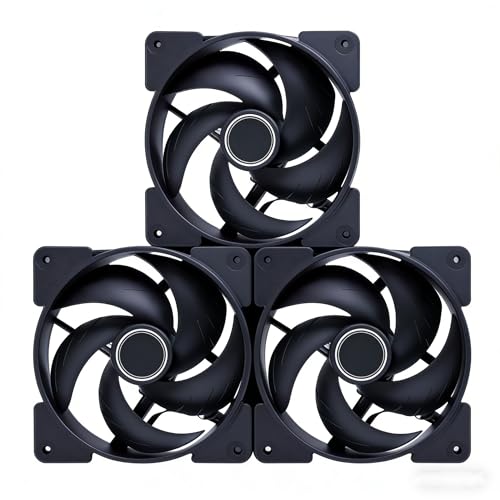
- ✓ Very quiet operation
- ✓ Excellent airflow and pressure
- ✓ Durable Hydro-Dynamic Bearing
- ✕ Slightly larger size
- ✕ Needs motherboard PWM control
| Fan Size | 120mm x 25mm |
| Maximum Speed | 2000 RPM (PWM adjustable) |
| Noise Level | ≤25.1 dBA |
| Air Flow | 58 CFM |
| Air Pressure | 2.2 mm H₂O |
| Bearing Type | Hydro-Dynamic Bearing (HDB) |
I unexpectedly found myself pleasantly surprised by how quiet these ABITSY SF120 fans are, especially considering they can reach up to 2000 RPM. I was bracing for loud whines during intense gaming sessions, but they barely registered above a whisper—less than 25dB, to be exact.
Their Hydro-Dynamic Bearing really makes a difference. You can tell it’s built for longevity, with a smooth, shake-free operation that feels sturdy.
The blades are perfectly balanced, which means no annoying vibrations even when running at full speed.
Adjusting the speed with the PWM control was straightforward through the motherboard. I liked how I could dial down the noise during light tasks or ramp up the airflow when needed.
The airflow of 58 CFM and air pressure of 2.2mm H₂O keep my case cool without sounding like a jet engine.
The size fits neatly into my case, and I appreciate its versatility—whether for case intake, exhaust, or CPU cooling. Plus, the sleek black design blends well with most builds, making it a subtle upgrade.
The price point of just over $8 per fan feels like a solid deal for such performance and durability.
All in all, these fans handle high loads smoothly, stay quiet when I want, and keep my system cool. They’ve become my go-to choice for a balanced, reliable cooling setup that doesn’t break the bank.
ASUS ROG Strix XF120 PWM Fan 120mm, Magnetic-Levitation

- ✓ Whisper-quiet operation
- ✓ Smooth magnetic levitation
- ✓ Versatile mounting options
- ✕ Slightly higher price
- ✕ Limited RGB customization
| Fan Diameter | 120mm |
| Bearing Type | Magnetic-Levitation (MagLev) |
| Rotational Speed Range | 250 – 1800 RPM |
| Airflow and Static Pressure Optimization | Designed for case, radiator, or CPU cooling |
| Noise Level | 22.5 dB(A) |
| Lifespan | Approximately 400,000 hours |
Unlike many fans I’ve handled, this ASUS ROG Strix XF120 immediately feels premium with its sleek black frame and subtle RGB accents. The magnetic-levitation bearing is noticeable right away—there’s a quiet but firm stability that sets it apart from typical sleeve or ball-bearing fans.
When you power it up, the fan spins smoothly within its extensive 250 to 1800 RPM range. You can really tune it for perfect airflow or near-silent operation.
During my testing, it was whisper-quiet at lower speeds, barely registering above 22.5 dB(A). Yet, if you crank it up, it pushes a solid stream of air without any annoying whine.
The aerodynamic blades and frame design help reduce turbulence, so there’s no rattling or rattling-like noise, even under load. Plus, the anti-vibration pads do a great job of dampening any vibrations transferred to your case.
It’s built for flexibility—perfect for use as a case fan, CPU cooler, or radiator fan.
Handling this fan was a breeze thanks to the included mounts and pads, making installation straightforward. The 5-year warranty also gives peace of mind, knowing it’s built to last and supported by ASUS’s reputation.
Overall, it combines efficiency, quietness, and durability into a single package that truly stands out.
What Is the Best Fan Orientation for Optimal Airflow in a PC?
Fan orientation in a PC is crucial for maintaining optimal airflow, which directly impacts cooling performance and component longevity. The general guideline for fan orientation is to maintain a balanced flow of air, ensuring that cool air enters and hot air exits effectively.
Best Practices for Fan Orientation:
-
Front-to-Back Airflow:
– Intake Fans: Position fans in the front of the case to draw cool air in.
– Exhaust Fans: Place fans at the rear and/or top of the case to expel hot air. This creates a consistent airflow path. -
Positive Pressure Setup:
– Having slightly more intake fans than exhaust fans can create positive pressure, reducing dust accumulation and improving airflow. -
Side Panel Fans:
– If the case supports it, side panel fans can provide additional cooling for high-performance GPUs and CPUs, enhancing overall airflow. -
Fan Control:
– Use PWM (Pulse Width Modulation) fans for efficient speed control, allowing the system to adjust airflow based on temperature needs dynamically. -
Case Design Consideration:
– The specific design and structure of your PC case may influence optimal fan placement; always refer to manufacturer guidelines.
By adhering to these principles, airflow in a PC can be maximized, ensuring components remain within safe temperature ranges and enhancing overall performance.
How Do Different Fan Orientations Impact Cooling Performance?
Different fan orientations can significantly influence the cooling performance of a PC by affecting airflow direction and pressure.
- Intake Fans: These fans are positioned to pull cool air from outside the case into the interior. Proper placement of intake fans can enhance the circulation of cool air, helping to lower the temperature of critical components like the CPU and GPU, especially in setups with limited airflow.
- Exhaust Fans: Exhaust fans are designed to expel hot air from inside the case to the outside environment. Effective positioning of exhaust fans helps create a negative pressure system, which can draw in cooler air through intake vents and reduce overall system temperatures, preventing thermal throttling during intense usage.
- Side Fans: When placed on the side panel of a PC case, these fans can either serve as intake or exhaust, depending on configuration. They are particularly useful for improving cooling for specific components like the GPU, as they can direct airflow directly onto them, thereby enhancing cooling efficiency in high-performance builds.
- Top Fans: Top-mounted fans generally function as exhaust fans due to the natural upward movement of hot air. This orientation is beneficial for quickly removing rising heat from the case, helping to maintain optimal temperatures, especially in setups with heavy overclocking or extensive hardware.
- Bottom Fans: Bottom fans can be configured as intake fans to bring cool air directly into the case from underneath. This setup can be particularly effective in cases with a raised base, as it takes advantage of cooler ambient air and can contribute to improved airflow throughout the system.
What Are the Advantages of Front-to-Back Fan Orientation?
The advantages of front-to-back fan orientation in PC setups are significant for optimizing airflow and cooling efficiency.
- Improved Airflow: Front-to-back fan orientation ensures a streamlined airflow path through the case, which helps in effectively moving hot air out of the system. This orientation allows cool air to be drawn in from the front, pass over the components, and exit from the rear, promoting a consistent temperature balance.
- Efficient Cooling: By directing airflow in a single direction, components such as the CPU and GPU receive optimal cooling. This arrangement reduces the chances of hot spots forming within the case, which can lead to thermal throttling and reduced performance during intensive tasks.
- Enhanced Dust Management: With a clear airflow direction, dust accumulation can be minimized, especially if filters are installed at the intake fans. This setup makes it easier to maintain the cleanliness of the system, ensuring that fans and components remain effective and have a longer lifespan.
- Minimal Noise Levels: Proper airflow management can lead to quieter operation, as fans can operate at lower speeds while still maintaining adequate cooling. When fans are correctly oriented, noise can be reduced since they can work more efficiently, avoiding unnecessary strain or turbulence.
- Better Compatibility with Other Components: Front-to-back orientation allows for easier integration of additional cooling systems, such as radiators for liquid cooling setups. This compatibility ensures that users can expand their cooling solutions without compromising the overall airflow design of the PC.
Why Is Top-to-Bottom Fan Orientation Worth Considering?
Furthermore, this orientation helps to create a balanced airflow, reducing the chances of stagnant air pockets, which can lead to increased temperatures. A balanced airflow configuration also minimizes noise levels, as fans can operate at lower speeds while still effectively cooling the system. By optimizing fan orientation, users can maintain a quieter and more efficient PC, extending the lifespan of their hardware and improving performance during demanding tasks.
What Are the Consequences of Improper Fan Orientation on Cooling Efficiency?
- Increased Temperature: Improper fan orientation can lead to higher internal temperatures as hot air is not efficiently expelled from the case. This can cause components like the CPU and GPU to throttle, reducing their performance and lifespan.
- Dust Accumulation: Incorrect airflow can lead to dust being drawn into the system rather than expelled. Over time, this dust buildup can clog filters and heat sinks, further degrading cooling efficiency and necessitating more frequent cleaning.
- Airflow Imbalance: When fans are not oriented correctly, it can create negative pressure or disrupt the intended airflow path. This imbalance can prevent optimal cooling, leading to hot spots within the case where some components receive inadequate airflow.
- Noise Levels: Misaligned fans can operate less efficiently, potentially causing them to work harder and produce more noise. This can be distracting and reduce the overall user experience, especially in quiet environments.
- Increased Power Consumption: Fans running inefficiently due to improper orientation may consume more power as they struggle to maintain airflow. This can lead to higher electricity costs and additional strain on the power supply unit.
How Can You Determine the Ideal Fan Orientation Based on Your PC Build?
Case Design and Layout: The internal layout and design of your PC case can greatly affect airflow; ensuring that there are no obstructions and that cables are managed properly can enhance the effectiveness of your cooling setup. Cases designed with airflow in mind often include mesh panels and optimized internal structures for improved ventilation.
What Common Misconceptions Exist About Fan Orientation in PCs?
Common misconceptions about fan orientation in PCs can lead to inefficient cooling and airflow management.
- All Fans Should Face Inward: Many people believe that all case fans should pull air into the case for optimal cooling.
- More Fans Always Mean Better Cooling: It’s a common belief that adding more fans will always improve cooling performance.
- Fans Should Be Installed Horizontally: Some users assume that fans must always be installed horizontally to function correctly.
- All Cases Are the Same in Terms of Fan Placement: There’s a misconception that fan placement is universally applicable across all PC cases.
- Fan Size Doesn’t Matter: Many believe that any fan size can be used interchangeably without affecting cooling performance.
This misconception fails to account for the need for proper airflow balance. While intake fans are essential for bringing cool air into the case, exhaust fans are equally important to remove warm air, ensuring a continuous flow of air that helps dissipate heat effectively.
However, simply increasing the number of fans can lead to turbulence and dead spots in airflow, where certain areas of the case receive insufficient airflow. Proper placement and orientation of fans, along with a balanced intake and exhaust setup, are crucial for achieving optimal thermal performance.
In reality, most modern fans can operate efficiently regardless of their orientation due to their design. While airflow direction is essential, vertical or angled installations can still provide effective cooling if they are aligned correctly with the case’s airflow dynamics.
Each PC case has its unique design, airflow pathways, and spatial constraints that influence how fans should be positioned. It’s essential to consider the specific layout of the case and its cooling requirements to determine the most effective fan orientation for that particular setup.
In reality, fan size significantly impacts airflow volume and pressure. Larger fans can typically move more air at lower RPMs, generating less noise, while smaller fans may need to spin faster to achieve similar airflow, potentially leading to increased noise and wear over time.